
Authored by: Hannah Hauer and Fernando Montoya, Associates
Powers’ Drug Pricing and 340B Program Practice Group
Overview
Manufacturers or PhRMA have challenged every state contract pharmacy law enacted to date. Despite the growing number of challenges, the results to date have overwhelmingly favored the state laws and the covered entities that those laws protect.
Recently, federal district courts in Arkansas, Colorado, Maine, Mississippi, New Mexico, South Dakota, and Vermont each rejected manufacturer challenges. Appeals to the Fifth and Eighth Circuits also resulted in wins for the states, including decisions involving contract pharmacy laws in Mississippi and Missouri. Powers represented Dallas County Medical Center as an intervenor in the recent Arkansas case, and the Missouri Hospital Association and Missouri Primary Care Association as intervenors in the Eighth Circuit’s Missouri decision.
While manufacturers’ claims to support these challenges varies, their arguments all rest on the contention that state contract pharmacy protection laws are unconstitutional. That argument depends on the premise that state laws are drug pricing statutes that are the purview of the 340B statute rather than laws regulating the delivery and distribution of 340B drugs. The vast majority of courts and particularly the most recent decisions in Arkansas, Colorado, Maine, Mississippi, Missouri, New Mexico, South Dakota, and Vermont have rejected the manufacturers’ reasoning and arguments, concluding instead that regulating pharmacy distribution is a traditional state function that does not violate the U.S. Constitution.
One outlier is the Fourth Circuit. Earlier this year, a divided three-judge panel found West Virginia’s and Maryland’s laws likely unconstitutional. But the full Fourth Circuit has since agreed to rehear both cases, making the Fourth Circuit the next major appellate decision to watch as a potential bellwether.
The Fourth Circuit Rehearing
Earlier this year, a divided three-judge panel vacated the District of Maryland’s denial of the manufacturers’ motion for a preliminary injunction and affirmed the Southern District of West Virginia’s grant of a preliminary injunction blocking West Virginia’s contract pharmacy law. The full Fourth Circuit agreed to rehear both cases, which is a positive development for covered entities. Granting rehearing vacates the panel decisions, so the Fourth Circuit currently has no binding ruling.
The Fourth Circuit is set to hear oral argument on October 27, 2026.
If the full court reverses the panel decisions, every federal court of appeals that issued a decision will have sided with the states, and manufacturers will head into the other pending appeals without support from other jurisdictions for their position. The next step after a circuit court decision would be to request review by the Supreme Court. The Supreme Court does not typically accept cases for review unless there are conflicting decisions from the circuit courts (a “circuit split”). If the Fourth Circuit rehearing results in a decision supporting the West Virginia and Maryland laws, it is unlikely that the Supreme Court would take review. If the Fourth Circuit instead adopts the panels’ reasoning, it will cement a split with the Fifth and Eighth Circuits and make Supreme Court review considerably more likely.
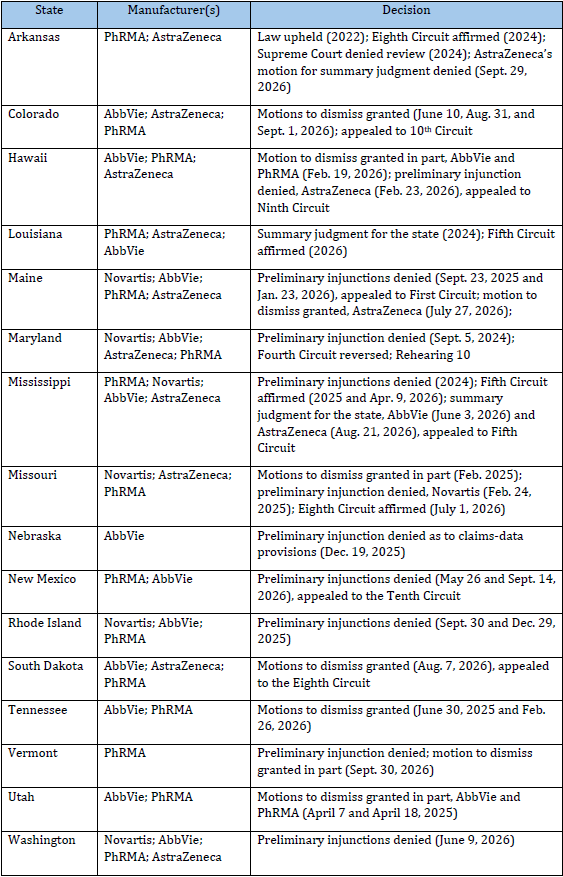
Below is a chart of all of the favorable District Court decisions to date.
Summary of All Favorable Decisions
Powers will continue to monitor developments regarding contract pharmacy litigation. Please contact Powers’ drug pricing team, or your lead Powers attorney, if you have any questions.
Authored By:


About Powers Law
Powers Pyles Sutter & Verville PC (“Powers”) is a Washington, D.C.-based law firm with national practices in healthcare, education, government relations, Indian tribal governments, and nonprofit law. Powers attorneys and professionals are nationally known for their extensive expertise in their practice areas and their commitment to client service. For more information, visit www.PowersLaw.com.